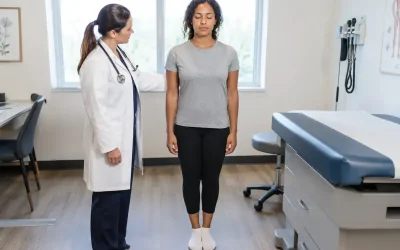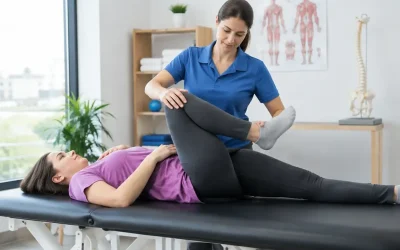
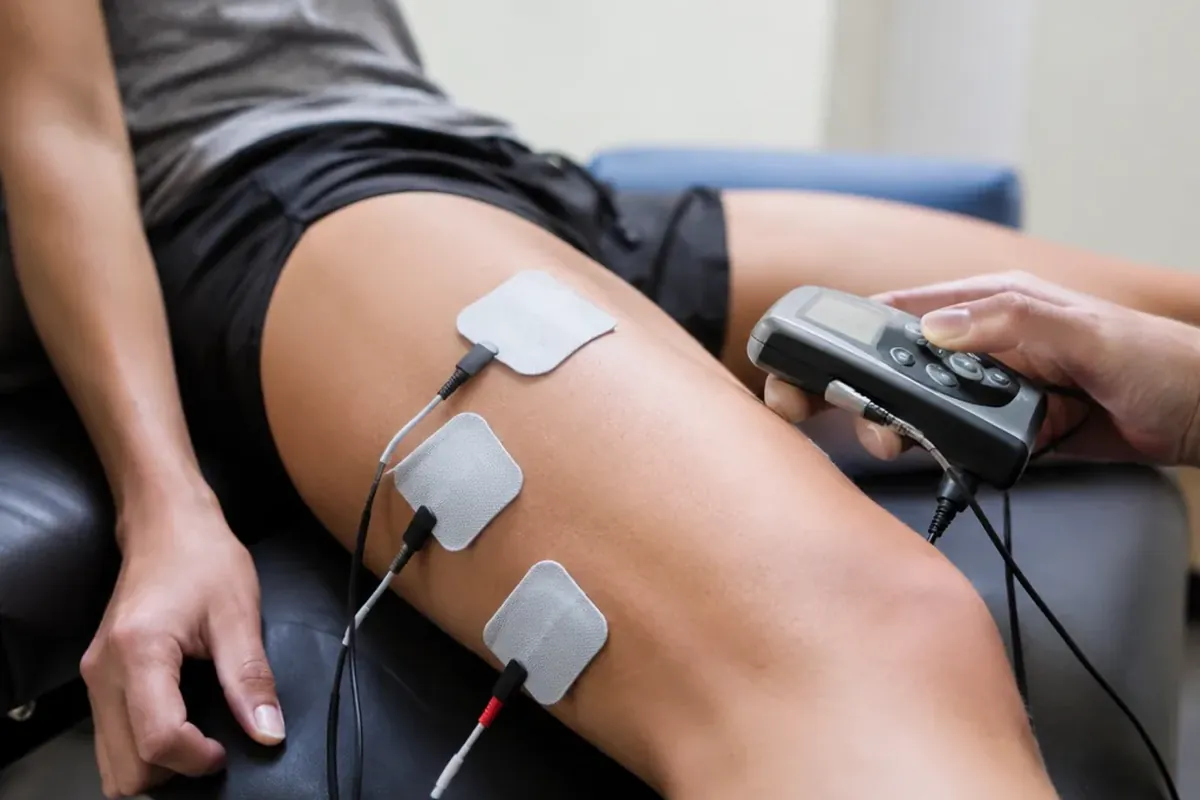
With an NMES machine, small electrical impulses make a weak or hard-to-activate muscle contract. In rehabilitation, that visible contraction can help preserve muscle, support relearning, and bridge the early period after surgery or neurologic injury when voluntary exercise is difficult. Rather than serving as a shortcut around rehabilitation, it is a tool your clinician may pair with movement and strengthening.
How an NMES Machine Creates a Muscle Contraction
Through surface electrodes placed on the skin, neuromuscular electrical stimulation delivers current. Near the neuromuscular junction, that current activates a motor nerve and leads to a muscle contraction. As a result, the signal bypasses the brain and spinal cord for that contraction, which is why a muscle can move even when you cannot fully recruit it on your own.
At low intensity, you may first notice tingling, tapping, or buzzing. As intensity rises, the feeling becomes a pulling or pumping sensation and the muscle should visibly twitch or contract. For rehabilitation, the setting needs to be strong enough for a visible or palpable contraction, not just a gentle tingle. Sharp or burning sensations are not expected.
During a session, you commonly experience a gradual ramp up, a hold, a ramp down, and a rest period. Because NMES recruits fast-fatiguing type II fibers early and in a synchronized pattern, rest matters: the off time is generally at least twice as long as the contraction. Depending on your plan, a clinician may use a programmed cycle or an EMG-triggered mode that starts stimulation when you attempt a small contraction.
NMES, EMS, TENS, and FES Have Different Jobs
With these names, a simple choice can feel confusing. In clinical settings, NMES is the usual term, while EMS, or electrical muscle stimulation, is the consumer term for essentially the same approach: both target motor nerves to produce muscle contractions. For that reason, a muscle stimulator differs from a device intended primarily for pain.
| Type | Primary target and purpose | What you typically feel or see |
|---|---|---|
| NMES / EMS | Motor nerves; activate a muscle for rehabilitation | A visible contraction; NMES typically uses 20–50 Hz |
| TENS | Sensory nerves; modulate pain signals | Tingling or pulsing, without a muscle contraction; TENS typically uses 50–150 Hz |
| FES | A form of NMES timed to a functional task | Stimulation coordinated with a movement, such as lifting the foot during walking |
Is EMS stronger than TENS? Because it must reach motor nerves deeply enough to contract a muscle, NMES/EMS generally uses a higher current intensity. “Stronger” does not mean better for every goal. For short-term pain relief during or immediately after use, TENS is aimed at pain modulation, while NMES is aimed at activation and function.
When Stimulation Can Help You Start Moving Again
When a muscle cannot yet be activated fully on purpose, physical therapists may use NMES. After ACL reconstruction, for example, the quadriceps can remain 15–40% weaker, sometimes for years. In this setting, evidence supports NMES as an addition to standard physical therapy after ACL surgery, especially when started early, to improve quadriceps strength.
In one trial after knee replacement, starting NMES 48 hours after surgery improved quadriceps strength and functional testing compared with standard rehabilitation alone. During immobilization, stimulation can help reduce muscle atrophy, preserve oxidative capacity, and improve circulation. In each case, account for the surgery, healing tissues, and your ability to participate safely in the treatment plan.
In neurologic rehabilitation, NMES also has a role. After stroke, studies have found improvement in upper-limb motor outcomes and activities of daily living, with the clearest effects in the subacute stage and for the upper limb. For swallowing rehabilitation, NMES may be added to conventional swallowing therapy under the direction of an appropriate clinician.
Why NMES Complements Exercise Instead of Replacing It
When weakness, pain, swelling, surgery, or a neurologic condition keeps you from fully firing a muscle, NMES is most useful. Think of it as a bridge: it can create a contraction while voluntary activation is limited, then support the transition to active movement and progressive strengthening.
Rather than replacing conventional exercise or strength training, it supports them. After surgery, the best-supported use is NMES added to active therapy. By pairing it with your attempt to contract or move the muscle, you may get the greatest benefit. For persistent low back pain, chronic pain, or osteoarthritis, NMES is not a universal answer; evidence is insufficient for many musculoskeletal conditions, and it is not recommended for osteoarthritis in the cited guidance.
What a Guided Home Session Usually Looks Like
For home use, units are commonly small, battery-powered, two-channel devices with programmed or adjustable settings. In the United States, a home NMES device used to treat a medical condition is generally prescription-only. From a video or another person’s unit, do not copy settings or electrode placement. On the exact device, your therapist should teach you and ask you or a caregiver to demonstrate the process back.
- Place the electrodes on clean, dry skin at the locations your therapist marked or taught you. Placement over a motor point can be more effective than placement over the center of the muscle.
- Turn on the unit and slowly raise the intensity until you see a strong, comfortable contraction.
- Let the programmed on-and-off cycles run, often for 20–30 minutes.
- Turn the unit off, remove the electrodes, and store them as instructed. Check for worn electrodes before the next use.
Depending on the plan, a common schedule is 20–30 minutes, three to five times a week. For a large thigh muscle, clinicians may use longer pulse durations and frequencies in the 30–50 Hz range. Do not treat those settings as a do-it-yourself prescription.
Safety Comes Before a Stronger Contraction
If you have an implanted pacemaker or ICD, do not use NMES. Never place electrodes over the front of the neck near the carotid sinus. During pregnancy, do not place them over the abdomen, lower back, or trunk. In these situations, electrical stimulation may interfere with an implant or trigger a dangerous response.
Before use over open wounds or infected skin, near a fresh fracture, recent surgical repair, metal implant, or recently sutured tendon, ask your doctor or therapist. Clinical guidance is also needed for epilepsy and reduced sensation in the treatment area. With reduced feeling, it is harder to judge intensity, which can raise the risk of skin injury.
If stimulation is painful, burning, causes concerning skin changes, or produces a response you were not taught to expect, stop and contact your clinician. Before starting, seek medical advice if you are recovering from surgery, have a neurologic condition, are pregnant, or have any implanted electronic device.
Three NMES Myths That Can Slow Recovery
If it tingles, it is training the muscle.
Not necessarily. By itself, tingling may mean the setting is below the level needed for a rehabilitation contraction. Instead, your clinician looks for a strong, visible or palpable contraction that remains tolerable.
More intensity and less rest will build strength faster.
Not with NMES. Because the recruited fibers fatigue quickly, the rest phase is part of the treatment. Outside your plan, increasing intensity or shortening rest can make the session less tolerable and may not improve the result.
TENS and NMES are interchangeable.
These devices are designed for different targets. A TENS unit may help with short-term pain relief, but it is not intended to create the muscle contraction used in NMES rehabilitation.
Frequently Asked Questions
What is the difference between NMES and EMS machines?
The method is essentially the same: both stimulate motor nerves to make a muscle contract. NMES is the term more often used in clinical and physiotherapy settings, while EMS is common in consumer language.
How does an NMES machine work?
Electrodes on the skin deliver electrical impulses to a motor nerve. This produces a visible muscle contraction without relying on your brain and spinal cord to start that particular contraction.
What are the benefits of using an NMES machine?
In the right rehabilitation plan, NMES can help limit atrophy during immobilization, support circulation, and assist muscle activation. Its strongest postoperative evidence is as an addition to therapy after ACL reconstruction.
What are the benefits of using a TENS machine?
TENS is used to modulate pain signals and may reduce pain intensity during or immediately after use. It does not provide the muscle contraction that NMES does, and it is not recommended for every pain condition.
When is NMES used instead of conventional exercise?
It may be used when you cannot activate a muscle adequately after surgery or after a neurologic injury. As voluntary control returns, it should support rather than replace active exercise and progressive strengthening.
How do NMES strength gains compare with strength training?
NMES can support strength recovery when activation is limited, but it does not replace progressive strength training. Research supports it best when it is added to active rehabilitation, not used alone.